

Commercial Property Review – April 2026
| UK Commercial real estate – Q1 capital values remained flat and 1.4% quarterly total returns driven by income returns | New business rates – new rateable values hit over two million non-domestic English properties from 1 April | Retail and hotel – experiential retail transforms the sector and UK hotel investment exceeds £1bn in Q1 |
Commercial market update
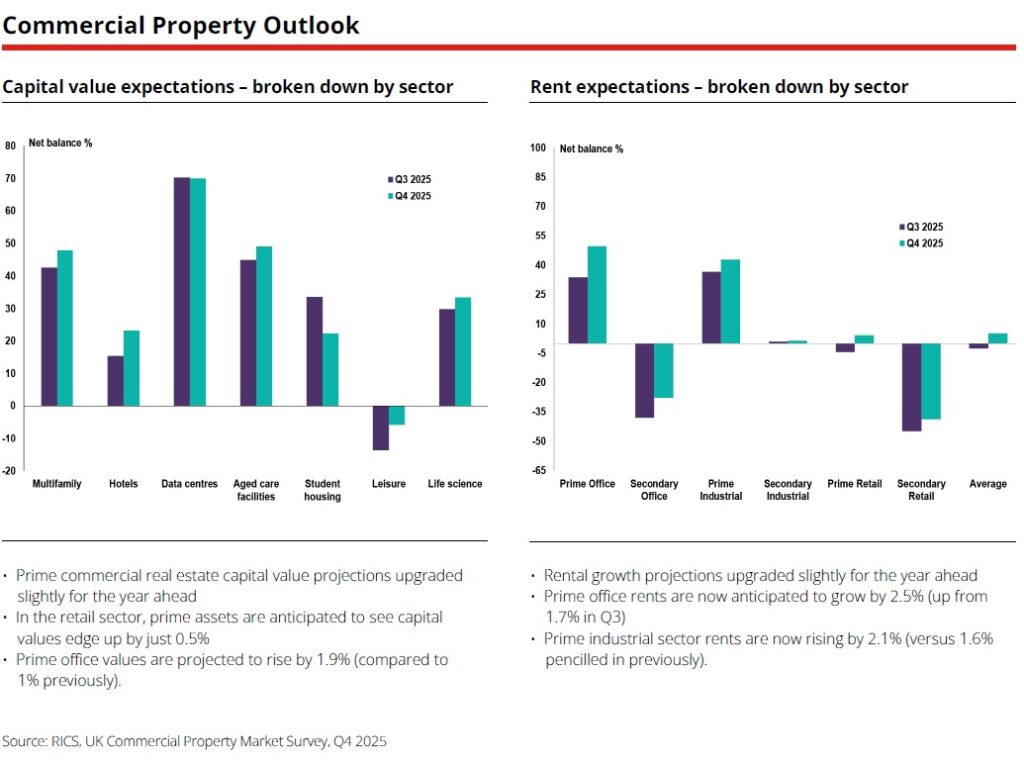
Data from CBRE shows that capital values for UK commercial real estate held steady in Q1, while total returns were at 1.4%, driven by income returns.
In Q1, the retail sector recorded the highest total returns at 1.7%. In March, retail rental values rose by 0.3%, driven by a 1.0% increase in shopping centre rents. Meanwhile, office total returns were slightly more modest in Q1 at 0.9% and capital values fell by 0.1% in March due to a decline in outer London/M25 and central London offices.
The industrial sector recorded the highest month-on-month total returns in March (0.6%). It was therefore the second-strongest sector in Q1, with quarterly returns of 1.6% and with all industrial segments showing consistent performance.
Steven Devaney at CBRE said, “We expect that income will remain the primary driver of performance through the rest of the year, with better performance anticipated from markets that have strong occupational fundamentals.”
Business rates revaluation
The rateable values of non-domestic properties have recently been updated, so businesses may notice changes to their tax bill.
Every three years, the rateable value of non-domestic properties is updated, which local councils use to calculate Business Rates bills. The latest revaluation came into effect on 1 April 2026 and will run until March 2029.
A rateable value is based on the amount of rent that a property could have reasonably been let for on a certain date – in the latest revaluation, this date is 1 April 2024. The rateable value is not necessarily the actual amount of rent paid on that date, nor is it the same as the actual Business Rates bill.
Not all businesses will be affected in the same way – some will face higher bills and some will see reductions. Businesses are able to challenge valuations they believe are incorrect.
Resurgence in retail
At the start of the decade, the retail sector was one of the weakest commercial asset classes due to the rise of online shopping. However, the sector is showing signs of strong recovery as it enters a new era.
Retailers have been forced to get creative and find new ways to bring consumers through their doors. Due to this, there has been a shift towards ‘experiential retail’ – where stores offer meaningful experiences that shoppers can’t get online. To achieve this, some shops now have interactive areas, cafes or product customisation to increase footfall. As a result, retail was the best performing property asset class in 2025, achieving a total return of 9.6% according to Knight Frank. Meanwhile, CBRE noted that vacancy rates decreased last year, with retail parks and central London streets being particularly popular areas. The improved sentiment is expected to continue in 2026, with CBRE forecasting annual retail sales growth of 1.9%.
A strong Q1 for hotels
It was a strong start to the year for the UK hotel sector, with investment volumes exceeding £1.1bn in quarter one. According to Savills, this marks a 63% increase when compared with the same period last year.
London was a key driver of this upward trend as the capital accounted for two-thirds (68%) of total Q1 sales. This was due to major transactions such as Park Plaza Waterloo and Radisson Blu Leicester Square.
Savills notes that the outlook for 2026 is positive, with liquidity improving and capital continuing to flow into the sector. Thomas Emanuel, Head of Hospitality Thought Leadership, commented, “The sharp uplift in Q1 investment volumes reflects strengthening investor confidence and the continued resilience of the UK hotel market. London remains a standout performer, particularly in the large scale and luxury segments, and we expect further transactional activity as new high‑quality stock comes to market.”
All details are correct at the time of writing (22 April 2026)
It is important to take professional advice before making any decision relating to your personal finances. Information within this document is based on our current understanding and can be subject to change without notice and the accuracy and completeness of the information cannot be guaranteed. It does not provide individual tailored investment advice and is for guidance only. Some rules may vary in different parts of the UK. We cannot assume legal liability for any errors or omissions it might contain. Levels and bases of, and reliefs from taxation are those currently applying or proposed and are subject to change; their value depends on the individual circumstances of the investor. No part of this document may be reproduced in any manner without prior permission.